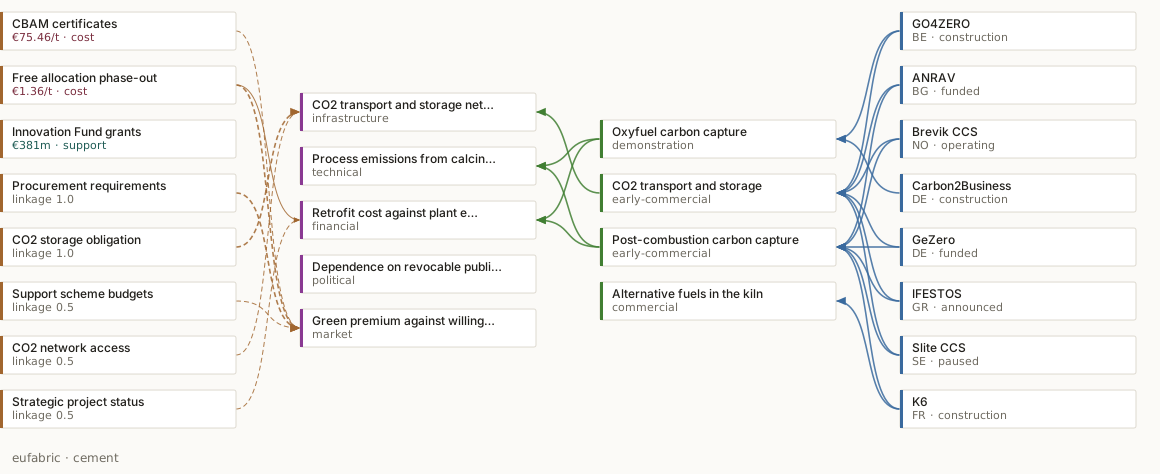
Post-combustion carbon capture early-commercial
CO2 is separated from the kiln's flue gas after combustion, using an amine or solvent process bolted onto an existing plant, which is what makes it the retrofit route for kilns that are not being rebuilt.
- Readiness
- early-commercial — Brevik, the first industrial-scale capture plant in the cement industry, opened on 18 June 2025 and is capturing at full scale. One operating plant is early-commercial, not commercial. source (2025-06-18)
- Abatement
- 50 % of plant CO2 emissions — The Brevik installation captures half the plant's emissions; it is a single-line retrofit, not a design ceiling for the technology.
- Cost
- 100–300 EUR million per plant retrofit — CEMBUREAU's own estimate, read from the Internet Archive; the live page serves a self-signed certificate.
- Depends on
- co2-transport-storage
- Deployed by
- Slite CCS, Brevik CCS, K6, GeZero, IFESTOS, ANRAV
Oxyfuel carbon capture demonstration
The kiln is fired with oxygen rather than air, so the flue gas is concentrated CO2 and needs far less separation, at the price of rebuilding the kiln rather than bolting equipment onto it.
- Readiness
- demonstration — Two full-scale oxyfuel kilns are under construction in Europe — GO4ZERO at Obourg and Carbon2Business at Lägerdorf — and none is operating. Under construction is demonstration. source (2024-05-16)
- Cost
- 100–360 EUR million per plant — €100 million to retrofit an existing kiln, €330-360 million for a new 1 Mt/year plant — the range spans two different projects, not one uncertainty.
- Depends on
- co2-transport-storage
- Deployed by
- GO4ZERO, Carbon2Business
CO2 transport and storage early-commercial
The pipelines, ships, terminals and permitted geological stores that a captured tonne has to reach before it counts as abated, and which no single cement plant can build for itself.
- Readiness
- early-commercial — Captured CO2 from Brevik is shipped and stored under the Norwegian Longship chain, which is the first full chain in Europe to take third-party industrial CO2. One chain in service is early-commercial. source (2025-06-18)
- Deployed by
- Slite CCS, Brevik CCS, GO4ZERO, GeZero, IFESTOS, ANRAV
Alternative fuels in the kiln commercial
Waste-derived and biomass fuels replace coal and petcoke in the kiln, which cuts combustion emissions and nothing else — the calcination CO2 is untouched, so this route has a ceiling below half the plant's emissions.
- Readiness
- commercial — Substitution rates are set as ordinary operating targets in plant investment plans rather than trialled; EQIOM's Lumbres line is built around 80% substitution by 2027. source (2024-02-15)
- Deployed by
- K6